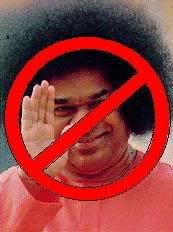
Sai Baba's Tattvavada Troubles 2
While reviewing Sai Baba's Tattvavada Troubles, I realised that I could undertake a little more in-depth clarification of some of the pertinent issues and explain why this is of significant importance for devotees of Sai Baba.
I have always held that Sai Baba's devotees are largely uneducated about the fundamentals of Vedantic philosophy and of the vast body of knowledge that exists in regards to spirituality. Of course, this is not a fault per se on their part but I rather think that simple reliance on Sai Baba's teachings and a blind belief that they represent the sum total of Vedantic philosophy is extremely foolish. As such, it would be of considerable benefit for Sai devotees to familiarise themselves with the very basics of philosophy if only to increase the scope of their education. It may very well involve breakdowns and renewals, but all for the better.
In the days of yore, young students would be sent to gurukulas (residential boarding schools) and be taught under the instruction of a guru for several years, in which they would learn the classics of Vedanta dialectics and gain some kind of qualification before attempting to speak on any subject. It befuddles me completely when I see Sai devotees discussing lofty spiritual issues with no clear indication of their qualifications on the subject. Needless to say, the reasoning they display in such discussion tends to reveal that they don't know what they are talking about. It may no longer be necessary for such long-winded processes such as attending gurukulas but the very minimum I would expect is for someone to have some basic understanding of the fundamental precepts of each school of Vedanta before attempting to speak on other elaborate issues.
In any case with all this talk of "poorna" avatars and the like, it is interesting to see that Sai Baba himself is largely responsible for the emphasis on this subject, stating that the hallmark of a poorna avatar lies in his possessing sixteen particular qualities (kalas). The first time I read of this idea was in Dr. Samuel Sandweiss' first book, 'Holy Man and the Psychiatrist', and he didn't seem very clear on what these sixteen qualities were. In fact, not very many of the Sai devotees I spoke to were very sure about it. I distinctly remember being asked about it even in Sai Baba's ashram on my first trip there, so it seems they don't know either! I eventually found an unclear mention from Sai Baba himself:
In any case, it is repeatedly mentioned in Sai literature that a poorna avatar is defined by the possession of all sixteen kalas, though how one may determine this in the case of Sai Baba remains unknown. However in the light of how this concept is seen within the Dvaita Vedanta philosophy it is safe to say that it would be treated derisively at best. The late Dr. B.N.K. Sharma was a devout Dvaitin and a scholarly academic who undertook valuable research in the subject and produced works of a superior quality in the field of Vedantic philosophy. I recently spotted his brief discussion of this subject in his famous work, 'Philosophy of Sri Madhvacharya':
Sri Madhvacharya is traditionally believed to be an incarnation 0f the deity Vayu in much the same way as Sri Sankaracharya (the founder of a rival school, Advaita Vedanta) is believed to be an incarnation of Shiva, though it would surprise me greatly if any Sai devotees knew this fact. Equally interesting is that Madhvacharya quotes a well-known verse from the Brihadaranyaka Upanishad (5.1) in support of his contention of 'equal' avatars, a verse that is known very well to Sai devotees and is frequently quoted in discourses by Sai Baba himself:
"The Personality of Godhead is perfect and complete, and because He is completely perfect, all emanations from Him, such as this phenomenal world, are perfectly equipped as complete wholes. Whatever is produced of the Complete Whole is also complete in itself. Because He is the Complete Whole, even though so many complete units emanate from Him, He remains the complete balance."
Though this translation was chosen in order to provide a broader meaning, the specific import of this terse statement relates to the innate 'completeness' of anything that emanates from the Complete Whole, in this case God. In other words, avatars are not regarded as "smaller portions" of the Supreme Lord, they are fully "complete" in themselves and are as complete as the Supreme Lord.
This in turn provides more and more evidence to support my contention that Sai Baba devotees are essentially uneducated about all of these things. In spite of repeating such mantras frequently, they appear to have little knowledge of the meaning of the same (despite Sai Baba's repeated urgings to chant with full knowledge of meanings!) or of their significance in dialectical positionings within Vedantic exegesis. I even wonder if Sai Baba himself knows the meaning of what he chants and tells others to chant; if he did or if he paid more attention to Vedanta dialectics he wouldn't make spurious claims to "full" avatarhood or even that his brand of spiritual teaching is all-inclusive! After all, how can Sai Baba claim anything "special" about his status when his claim doesn't even exist in the Dvaita Vedanta religious paradigm? :-)
I have always held that Sai Baba's devotees are largely uneducated about the fundamentals of Vedantic philosophy and of the vast body of knowledge that exists in regards to spirituality. Of course, this is not a fault per se on their part but I rather think that simple reliance on Sai Baba's teachings and a blind belief that they represent the sum total of Vedantic philosophy is extremely foolish. As such, it would be of considerable benefit for Sai devotees to familiarise themselves with the very basics of philosophy if only to increase the scope of their education. It may very well involve breakdowns and renewals, but all for the better.
In the days of yore, young students would be sent to gurukulas (residential boarding schools) and be taught under the instruction of a guru for several years, in which they would learn the classics of Vedanta dialectics and gain some kind of qualification before attempting to speak on any subject. It befuddles me completely when I see Sai devotees discussing lofty spiritual issues with no clear indication of their qualifications on the subject. Needless to say, the reasoning they display in such discussion tends to reveal that they don't know what they are talking about. It may no longer be necessary for such long-winded processes such as attending gurukulas but the very minimum I would expect is for someone to have some basic understanding of the fundamental precepts of each school of Vedanta before attempting to speak on other elaborate issues.
In any case with all this talk of "poorna" avatars and the like, it is interesting to see that Sai Baba himself is largely responsible for the emphasis on this subject, stating that the hallmark of a poorna avatar lies in his possessing sixteen particular qualities (kalas). The first time I read of this idea was in Dr. Samuel Sandweiss' first book, 'Holy Man and the Psychiatrist', and he didn't seem very clear on what these sixteen qualities were. In fact, not very many of the Sai devotees I spoke to were very sure about it. I distinctly remember being asked about it even in Sai Baba's ashram on my first trip there, so it seems they don't know either! I eventually found an unclear mention from Sai Baba himself:
“Now again, amongst the descending Avatars, there are POORNA AVATARS. Poorna Avatars are the Masters of the sixteen kalas. The fifteen kalas are : The five Karmendriyas or working organs which have to do with talking, taking, walking, rejecting (exertion) and eating. The five Jnanendriyas or sense organs: hearing, touch, sight, taste, smell, and Panch Mahabhootas or the five elements: earth, water, fire, air, space. The 16th Kala: the all - knowing Paramatma (the Omniscient, Omnipotent and Omnipresent aspect)." - John S. Hislop, 'Conversations with Bhagavan Sri Sathya Sai Baba'.
In any case, it is repeatedly mentioned in Sai literature that a poorna avatar is defined by the possession of all sixteen kalas, though how one may determine this in the case of Sai Baba remains unknown. However in the light of how this concept is seen within the Dvaita Vedanta philosophy it is safe to say that it would be treated derisively at best. The late Dr. B.N.K. Sharma was a devout Dvaitin and a scholarly academic who undertook valuable research in the subject and produced works of a superior quality in the field of Vedantic philosophy. I recently spotted his brief discussion of this subject in his famous work, 'Philosophy of Sri Madhvacharya':
"The Supreme Lord of all creation remains wrapped up in His glory and bliss at a time when the entire universe is in a state of nebulous chaos (Rig Veda 10.129.2-3). Later, He puts on a multiplicity of forms to evolve the universe through different stages. These forms, though innumerable, are nevertheless identical with one another, save for their numerical distinction. The first in the order of divine manifestations is the quarternion of Vasudeva, Pradyumna, Aniruddha and Sankarsana, popularly known as the Catur-Vyuha, credited with redemptive, creative, sustaining and destructive functions.
"The Supreme further differentiates itself into ten (familiar avatars) or twelve, hundred, thousand and so on ... But there is one important different that in Madhva's view, these various manifestations are absolutely on a par with one another. There is no gradation among them in respect of powers or potentialities. Madhva is vehemently opposed to the idea of making any invidious distinctions among these manifestations of God or putting some on a higher pedestal than others. There is no room for 'svagatabheda' (internal difference) in the Supreme (neha nanasti kincana). It is the same Infinite in every manifestation ... To Madhva all avatars are of equal merit and status. There is no question of degree of fullness among them, no 'partial' and 'complete' avataras. He takes his uncompromising stand on the authority of the Upanisads and Pancaratric texts ... He has thus no partiality or preference for any particular avatar of God and treats all of them as equal in rank, attributes and powers". - 'Philosophy of Sri Madhvacharya', p. 353-355.
Sri Madhvacharya is traditionally believed to be an incarnation 0f the deity Vayu in much the same way as Sri Sankaracharya (the founder of a rival school, Advaita Vedanta) is believed to be an incarnation of Shiva, though it would surprise me greatly if any Sai devotees knew this fact. Equally interesting is that Madhvacharya quotes a well-known verse from the Brihadaranyaka Upanishad (5.1) in support of his contention of 'equal' avatars, a verse that is known very well to Sai devotees and is frequently quoted in discourses by Sai Baba himself:
pūrṇamadaḥ pūrṇamidaṁ pūrnāt pūrṇamudacyate |
pūrṇasya pūrṇamādāya pūrṇamevāvaśiṣyate ||
pūrṇasya pūrṇamādāya pūrṇamevāvaśiṣyate ||
"The Personality of Godhead is perfect and complete, and because He is completely perfect, all emanations from Him, such as this phenomenal world, are perfectly equipped as complete wholes. Whatever is produced of the Complete Whole is also complete in itself. Because He is the Complete Whole, even though so many complete units emanate from Him, He remains the complete balance."
Though this translation was chosen in order to provide a broader meaning, the specific import of this terse statement relates to the innate 'completeness' of anything that emanates from the Complete Whole, in this case God. In other words, avatars are not regarded as "smaller portions" of the Supreme Lord, they are fully "complete" in themselves and are as complete as the Supreme Lord.
This in turn provides more and more evidence to support my contention that Sai Baba devotees are essentially uneducated about all of these things. In spite of repeating such mantras frequently, they appear to have little knowledge of the meaning of the same (despite Sai Baba's repeated urgings to chant with full knowledge of meanings!) or of their significance in dialectical positionings within Vedantic exegesis. I even wonder if Sai Baba himself knows the meaning of what he chants and tells others to chant; if he did or if he paid more attention to Vedanta dialectics he wouldn't make spurious claims to "full" avatarhood or even that his brand of spiritual teaching is all-inclusive! After all, how can Sai Baba claim anything "special" about his status when his claim doesn't even exist in the Dvaita Vedanta religious paradigm? :-)
Labels: Outside Views, Philosophical Problems, Religion, Sai Baba, Theological Thoughts, Vedanta
Copyright © Sai Baba EXPOSED! 2005-2007. Discuss this post!
posted by Swami Saiexposedananda at
05:11
|
10 comments